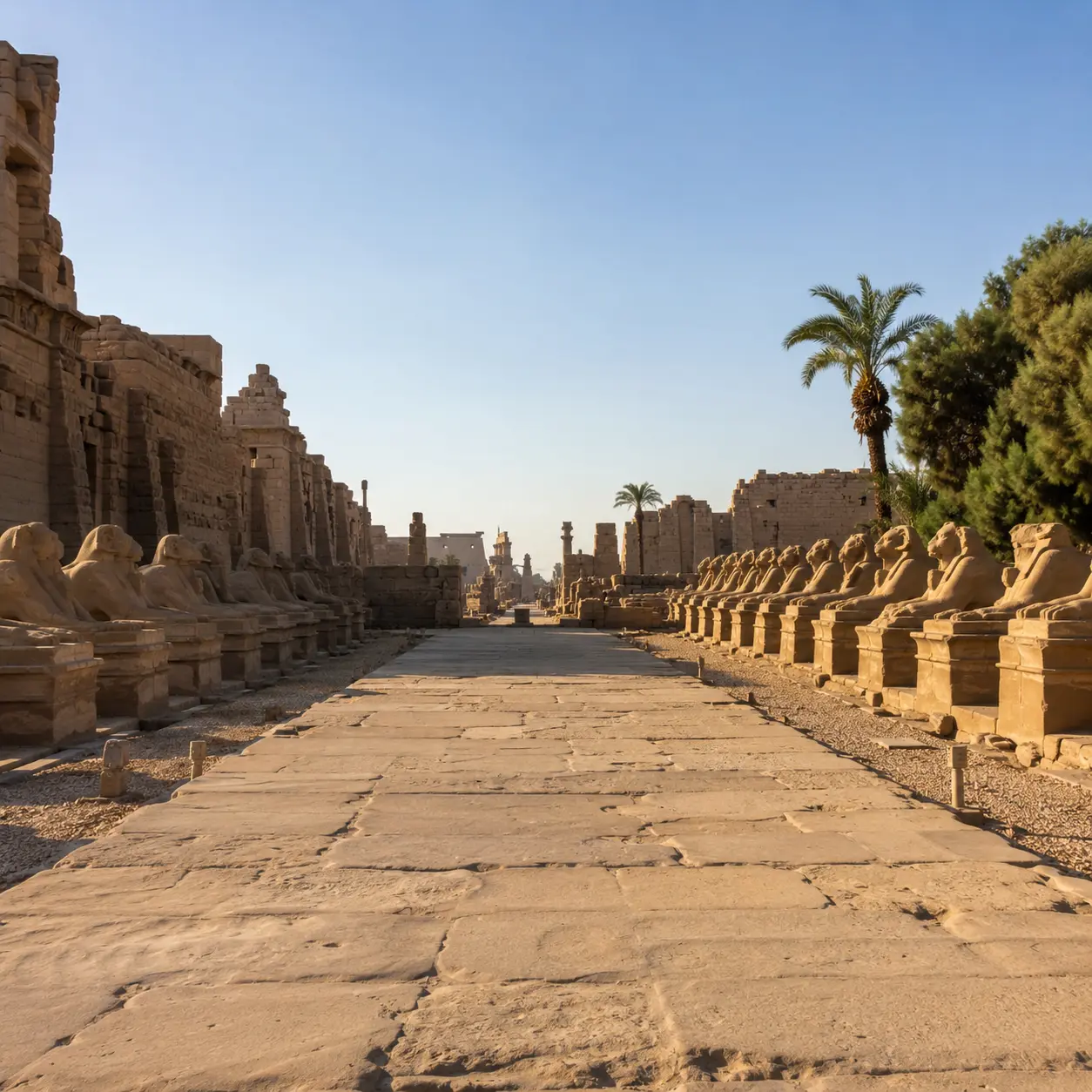
Avenue of Sphinxes
The Avenue of Sphinxes in Luxor is an ancient processional road lined with sphinx statues, connecting Karnak Temple with Luxor Temple and recalling the city’s grand religious festivals.


Plan your visit
- Opening hours
- Access times may vary by season, security arrangements, and the section you plan to visit. Check current opening guidance locally before you go, especially if you want to visit early morning, around sunset, or after dark as part of a Luxor Temple visit.
- Best time
- The best time to visit the Avenue of Sphinxes is early morning or late afternoon, when the light is softer and the temperature is more comfortable. Sunset into early evening can be especially atmospheric if combined with Luxor Temple, but check local access and ticket arrangements before planning around twilight.
- Visit duration
- Plan around 30 to 60 minutes for a focused visit, or longer if you walk extended sections and combine the avenue with nearby temple sightseeing.
- Category
- History & Ancient Wonders
- Location
About
The Avenue of Sphinxes is Luxor’s ancient ceremonial road, a stone-lined processional way that once linked the great temple precinct of Karnak with Luxor Temple. Walking it today gives you a rare feeling in Egypt: instead of seeing a single monument, you follow the space between monuments, the route priests, musicians, officials, and festival crowds used when sacred barques moved through the city.
The avenue is lined with rows of sphinxes, many with human heads and lion bodies, set on low plinths along a broad paved route. Some are weathered to soft outlines; others still show clear paws, chests, and faces. That mix is part of the appeal. You see not only ancient grandeur, but also the long life of the city that grew over, around, and beside it.
Its story is closely tied to the Opet Festival, one of ancient Thebes’ major religious celebrations. During the festival, divine statues connected with Amun, Mut, and Khonsu were carried between Karnak and Luxor Temple. The avenue was not simply a road. It was a ritual stage, built for movement, sound, incense, and public ceremony.
Most travellers experience the Avenue of Sphinxes as part of a wider Luxor East Bank visit. It makes the strongest impression when paired with Karnak’s vast temple halls and the evening atmosphere at Luxor Temple. Seen together, the three sites explain why ancient Thebes was more than a collection of temples; it was a living sacred landscape.
The walk is open and exposed, with long sightlines, stone paving, and limited shade in parts. In the cooler months, it can be a calm, atmospheric place to pause between bigger-ticket sights. In hotter weather, it is best visited early or late, when the stone is less glaring and the carvings are easier to read in angled light.
For photographers, the Avenue of Sphinxes rewards patience. Rather than trying to capture every statue, look for repetition: paws in a line, plinths catching low sun, a sphinx face framed against palm trees or city buildings. The contrast between modern Luxor and ancient stone is not a flaw in the view; it is the point. This is a monument that has re-emerged inside a living city.
If you are planning a deeper Luxor itinerary, the avenue works well as a gentle bridge between temple visits, museums, and West Bank tombs. Browse more ideas for time in Luxor if you want to connect the East Bank with places such as the Valley of the Kings, noble tombs, and riverside viewpoints.
Avenue of Sphinxes is one of Luxor's most-visited history & ancient wonders spots. Plan around The best time to visit the Avenue of Sphinxes is early morning or late afternoon, when the light is softer and the temperature is more comfortable. Sunset into early evening can be especially atmospheric if combined with Luxor Temple, but check local access and ticket arrangements before planning around twilight. for the best conditions, and budget roughly Plan around 30 to 60 minutes for a focused visit, or longer if you walk extended sections and combine the avenue with nearby temple sightseeing. on-site. Visit early to avoid crowds and heat.

Why travelers visit
Visit the Avenue of Sphinxes to understand Luxor as an ancient ceremonial city, not just a place of separate temples. It turns the distance between Karnak and Luxor Temple into part of the story, giving scale, movement, and ritual meaning to the East Bank.
Highlights
 Ancient ceremonial route connecting Karnak Temple and Luxor Temple
- Rows of sphinx statues with powerful repeated forms and weathered details
- Strong context for understanding the Opet Festival and ancient Thebes
- Excellent add-on to a Luxor East Bank temple visit
- Atmospheric photography in low morning or late afternoon light
Photos
1 photos
Know before you go
Practical tips to make the most of your visit.

What to wear
Wear comfortable walking shoes with good grip, as surfaces can be uneven. Light breathable clothing, sunglasses, a hat, and sunscreen are useful for daytime visits. In cooler months or evening, bring a light layer, especially if you continue to Luxor Temple after sunset.

Is a guide recommended?
Pause at one end of the avenue before walking. Look down the line of sphinxes and imagine the route as a moving ceremony, not a silent ruin. That shift changes the whole visit.

Common mistakes to avoid
- Treating it as a quick photo stop only; the avenue makes more sense when you understand its link between Karnak and Luxor Temple.
- Visiting at midday in hot weather without shade, water, or sun protection.
- Expecting every sphinx to be perfectly preserved; many are fragmentary, restored, or weathered, which is normal for an ancient outdoor monument.
- Skipping a guide or context; without the Opet Festival story, the site can feel like a long line of statues rather than a ceremonial route.
- Trying to walk too much in one go during peak heat, especially with children or older travellers.
Frequently asked questions
Where is the Avenue of Sphinxes located?
The Avenue of Sphinxes is in Luxor on the East Bank of the Nile, running between Karnak Temple and Luxor Temple. It sits within the modern city, so it is easy to combine with other East Bank sights.
Is the Avenue of Sphinxes worth visiting?
Yes, the Avenue of Sphinxes is worth visiting if you are already seeing Karnak or Luxor Temple. It helps you understand how the two temples were connected during ancient religious processions.
How long do you need at the Avenue of Sphinxes?
You can usually see key sections in about 30 to 60 minutes, depending on how much you walk and how often you stop for photos. Allow longer if you are visiting with a guide who explains the festival route and temple connections.
What was the Avenue of Sphinxes used for?
The avenue connected Karnak Temple and Luxor Temple as a ceremonial route used in ancient festivals. Its most famous association is with the Opet Festival, when sacred images were moved through Thebes in public ritual.
What should I combine with the Avenue of Sphinxes?
It is best visited with Karnak Temple and Luxor Temple on the same East Bank route. Seeing all three together gives the clearest picture of ancient Thebes and its religious landscape.
Do I need a guide for the Avenue of Sphinxes?
You do not strictly need a guide, but a guide makes the visit much more meaningful. The site is visually simple at first glance, and the history of the processions, temple axis, and restoration is easy to miss without explanation.
Visitor info
- Opening hours
- Access times may vary by season, security arrangements, and the section you plan to visit. Check current opening guidance locally before you go, especially if you want to visit early morning, around sunset, or after dark as part of a Luxor Temple visit.
- Recommended visit
- Plan around 30 to 60 minutes for a focused visit, or longer if you walk extended sections and combine the avenue with nearby temple sightseeing.
- Best time to visit
- The best time to visit the Avenue of Sphinxes is early morning or late afternoon, when the light is softer and the temperature is more comfortable. Sunset into early evening can be especially atmospheric if combined with Luxor Temple, but check local access and ticket arrangements before planning around twilight.
- Category
- History & Ancient Wonders
How to get there
Open in Google Maps
Reviews

Find guided Egypt tours that include this attraction.