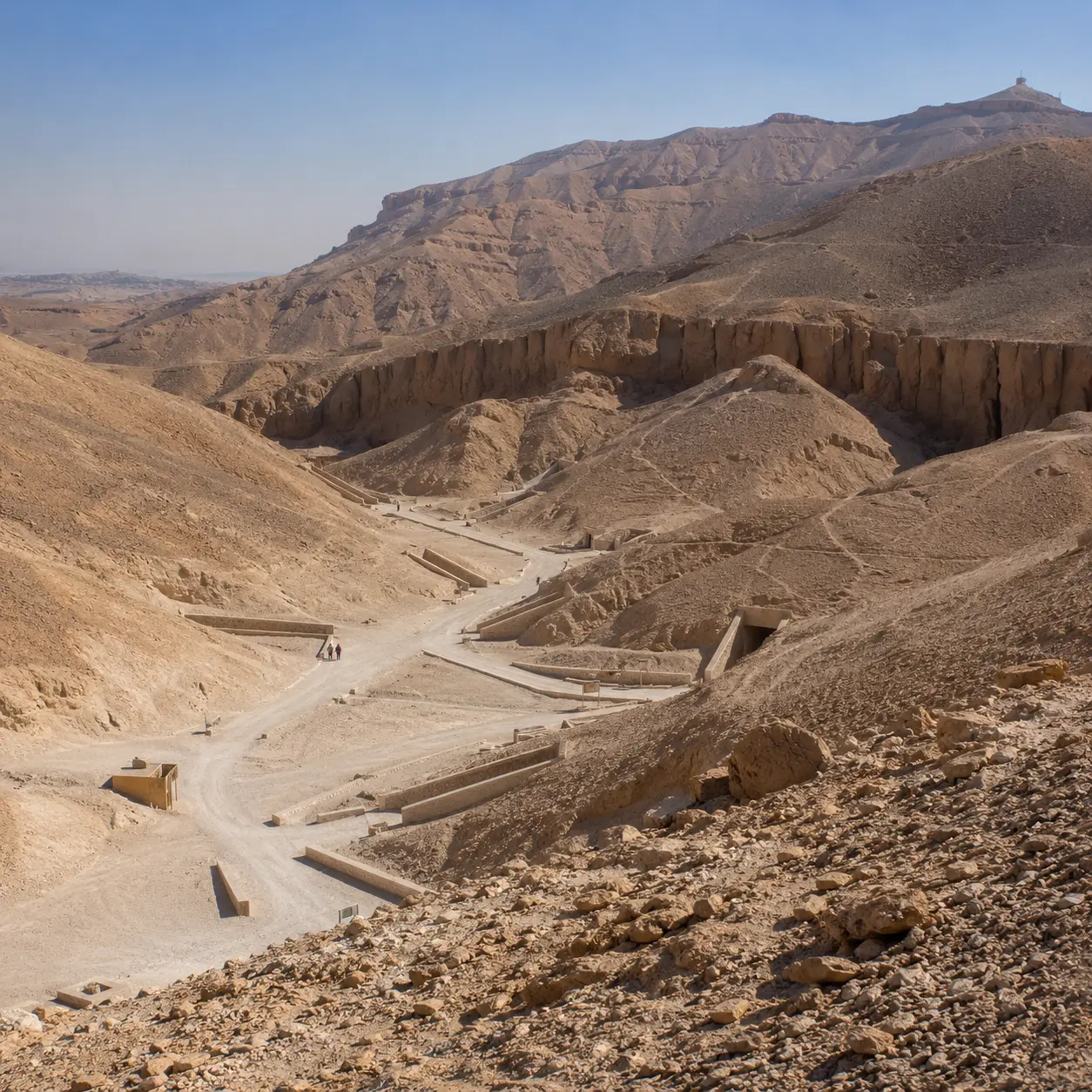
Valley of the Kings
The Valley of the Kings is Luxor’s legendary royal burial ground, where New Kingdom pharaohs were buried in painted tombs carved into the desert cliffs of the West Bank.


Plan your visit
- Opening hours
- The Valley of the Kings generally opens in the morning and closes by late afternoon, but exact hours can vary by season, local conditions and official decisions. Check current times shortly before your visit, especially during holidays or extreme heat, and aim to arrive early rather than close to last entry.
- Best time
- The best time to visit the Valley of the Kings is early morning, when temperatures are usually cooler and the site feels calmer. The cooler months of the year are generally more comfortable for walking around Luxor’s West Bank. In hotter periods, avoid lingering in the open desert areas at midday and plan short breaks between tombs.
- Visit duration
- Plan around two to three hours for the Valley of the Kings. Add more time if you want special-entry tombs, are visiting at a slower pace, or are combining the site with other West Bank stops.
- Category
- History & Ancient Wonders
- Location
About
The Valley of the Kings is the great royal cemetery of ancient Thebes, cut into the dry limestone hills on Luxor’s West Bank. For several centuries of the New Kingdom, pharaohs and powerful nobles chose this desert valley for their burial chambers, moving away from pyramid-style monuments toward tombs concealed in the cliffs. The result is one of Egypt’s most atmospheric ancient sites: a bare, sunlit landscape outside, then sudden corridors of painted gods, starry ceilings, boats of the afterlife and scenes from sacred funerary texts inside.
A visit here is different from seeing a temple. Temples such as Karnak’s vast complex were built for public ritual, processions and offerings. The tombs in the Valley of the Kings were private, sealed spaces designed for the king’s journey after death. That difference changes the mood. You walk down sloping passages where the air cools slightly, your footsteps become softer, and the colour on the walls can still feel startling after thousands of years: deep blues, ochres, reds and crisp black outlines.
Most standard visits include access to a selection of open tombs, which can change for conservation reasons. Some famous tombs, such as Tutankhamun’s, are typically treated as special-entry tombs with separate tickets. It is best not to build your whole visit around one tomb being open. Instead, plan for the valley as a whole: the setting, the craftsmanship, the variety of tomb layouts, and the rare chance to stand inside royal burial chambers rather than simply view objects in a museum case.
The site is exposed, dry and bright. There is little shade between the visitor centre, the shuttle area and the tomb entrances, and the pale rock reflects heat. Early morning is usually the most comfortable time, especially outside the cooler winter months. Bring water, a hat and sunglasses, but keep the mood respectful inside the tombs: voices carry in the narrow corridors, and photography rules may vary by tomb and ticket type.
A guide adds real value here. The walls are not decoration in the modern sense; they are texts, prayers and maps for the afterlife. A good Egyptologist can explain why the sun god appears in the underworld, why some ceilings are covered in stars, and why tombs differ from one reign to another. Guides usually explain key scenes outside the tombs as well, since speaking may be limited inside some chambers.
If you are planning a wider Luxor stay, pair the Valley of the Kings with West Bank sites such as mortuary temples and artisan tombs, then balance it with the East Bank’s temple architecture. Travellers comparing routes can browse Luxor-focused Egypt trips or combine the city with a Nile cruise route for a slower look at Upper Egypt.
The most rewarding approach is to slow down. Do not rush from one tomb to the next just to count names. Choose a few, notice the angle of the corridors, the change in colour, the unfinished patches, the protective glass, the burnished stone underfoot. The Valley of the Kings is not only about royal death; it is about the skill, labour and belief system that shaped ancient Egypt at its most powerful.
Valley of the Kings is one of Luxor's most-visited history & ancient wonders spots. Plan around The best time to visit the Valley of the Kings is early morning, when temperatures are usually cooler and the site feels calmer. The cooler months of the year are generally more comfortable for walking around Luxor’s West Bank. In hotter periods, avoid lingering in the open desert areas at midday and plan short breaks between tombs. for the best conditions, and budget roughly Plan around two to three hours for the Valley of the Kings. Add more time if you want special-entry tombs, are visiting at a slower pace, or are combining the site with other West Bank stops. on-site. Visit early to avoid crowds and heat.

Why travelers visit
Visit the Valley of the Kings to step inside the burial landscape of Egypt’s New Kingdom pharaohs. Few sites combine such a stark desert setting with such intimate, detailed ancient art, making it one of Luxor’s most important history experiences.
Highlights
 Painted royal tomb corridors carved deep into the limestone hills of Luxor’s West Bank.
- Powerful funerary scenes showing gods, solar boats, star ceilings and the king’s journey through the afterlife.
- A stark desert setting that makes the decorated interiors feel even more dramatic.
- The option to add special-entry tombs when available, including some of the valley’s most famous burials.
- Excellent context for understanding the New Kingdom after visiting Luxor’s temples and museums.
Photos
1 photos
Know before you go
Practical tips to make the most of your visit.

What to wear
Wear light, breathable clothing, a hat, sunglasses and comfortable walking shoes with grip. Shoulders and knees do not need the same level of coverage as in a mosque, but modest, practical clothing is still best for sun protection and comfort. Carry water and avoid heavy bags inside narrow tomb corridors.

Is a guide recommended?
Choose tombs for variety, not just fame. On many visits, a less crowded tomb with vivid colour and a clear layout is more rewarding than queuing for the best-known name. I also suggest listening to your guide’s explanation outside each tomb first, then walking in quietly so you can focus on the walls rather than trying to process everything at once.

Common mistakes to avoid
- Arriving late in the day and underestimating how intense the West Bank heat can feel.
- Assuming every famous tomb is included in the standard ticket; some require separate entry and availability can change.
- Trying to see too many tombs quickly instead of spending proper time in a few well-chosen ones.
- Forgetting that photography rules can vary and may be enforced differently in tomb interiors.
- Skipping a guide and missing the meaning behind the painted scenes and burial texts.
- Wearing slick sandals; the paths and tomb passages are easier in shoes with grip.
Frequently asked questions
Is the Valley of the Kings worth visiting?
Yes, the Valley of the Kings is worth visiting because it gives you direct access to royal tombs with some of Egypt’s finest surviving wall paintings. It feels very different from temples or museum galleries, and it is one of the essential ancient sites in Luxor.
How long do you need at the Valley of the Kings?
You usually need around two to three hours for a comfortable Valley of the Kings visit. This allows time for the visitor area, transport inside the site, several tombs and short breaks from the sun.
Is Tutankhamun’s tomb included in the Valley of the Kings ticket?
No, Tutankhamun’s tomb is often not included in the standard entry ticket and may require a separate ticket. Availability and ticket rules can change, so confirm at the ticket office or with your guide before entering the site.
What is the best time of day to visit the Valley of the Kings?
Early morning is the best time to visit the Valley of the Kings because the heat is usually lower and the tomb areas are easier to enjoy. It also gives you more flexibility if you plan to continue to other West Bank sites afterwards.
Do I need a guide for the Valley of the Kings?
A guide is strongly recommended for the Valley of the Kings because the tomb scenes are full of symbols, gods and afterlife texts that are not obvious at first glance. You can visit independently, but a knowledgeable guide makes the experience much clearer.
Can you take photos inside the tombs?
Photography rules at the Valley of the Kings vary by area, tomb and ticket type. Always check the current rules before taking photos, and avoid flash or touching walls under any circumstances.
Visitor info
- Opening hours
- The Valley of the Kings generally opens in the morning and closes by late afternoon, but exact hours can vary by season, local conditions and official decisions. Check current times shortly before your visit, especially during holidays or extreme heat, and aim to arrive early rather than close to last entry.
- Recommended visit
- Plan around two to three hours for the Valley of the Kings. Add more time if you want special-entry tombs, are visiting at a slower pace, or are combining the site with other West Bank stops.
- Best time to visit
- The best time to visit the Valley of the Kings is early morning, when temperatures are usually cooler and the site feels calmer. The cooler months of the year are generally more comfortable for walking around Luxor’s West Bank. In hotter periods, avoid lingering in the open desert areas at midday and plan short breaks between tombs.
- Category
- History & Ancient Wonders
How to get there
Open in Google Maps
Reviews

Find guided Egypt tours that include this attraction.