Best Ancient Egyptian Temples to Visit in Egypt
A practical guide to the best ancient Egyptian temples to visit, from Karnak and Luxor to Philae, Edfu, Kom Ombo, Dendera, and Abu Simbel.

Ozes
Travel Writer

A practical guide to the best ancient Egyptian temples to visit, from Karnak and Luxor to Philae, Edfu, Kom Ombo, Dendera, and Abu Simbel.
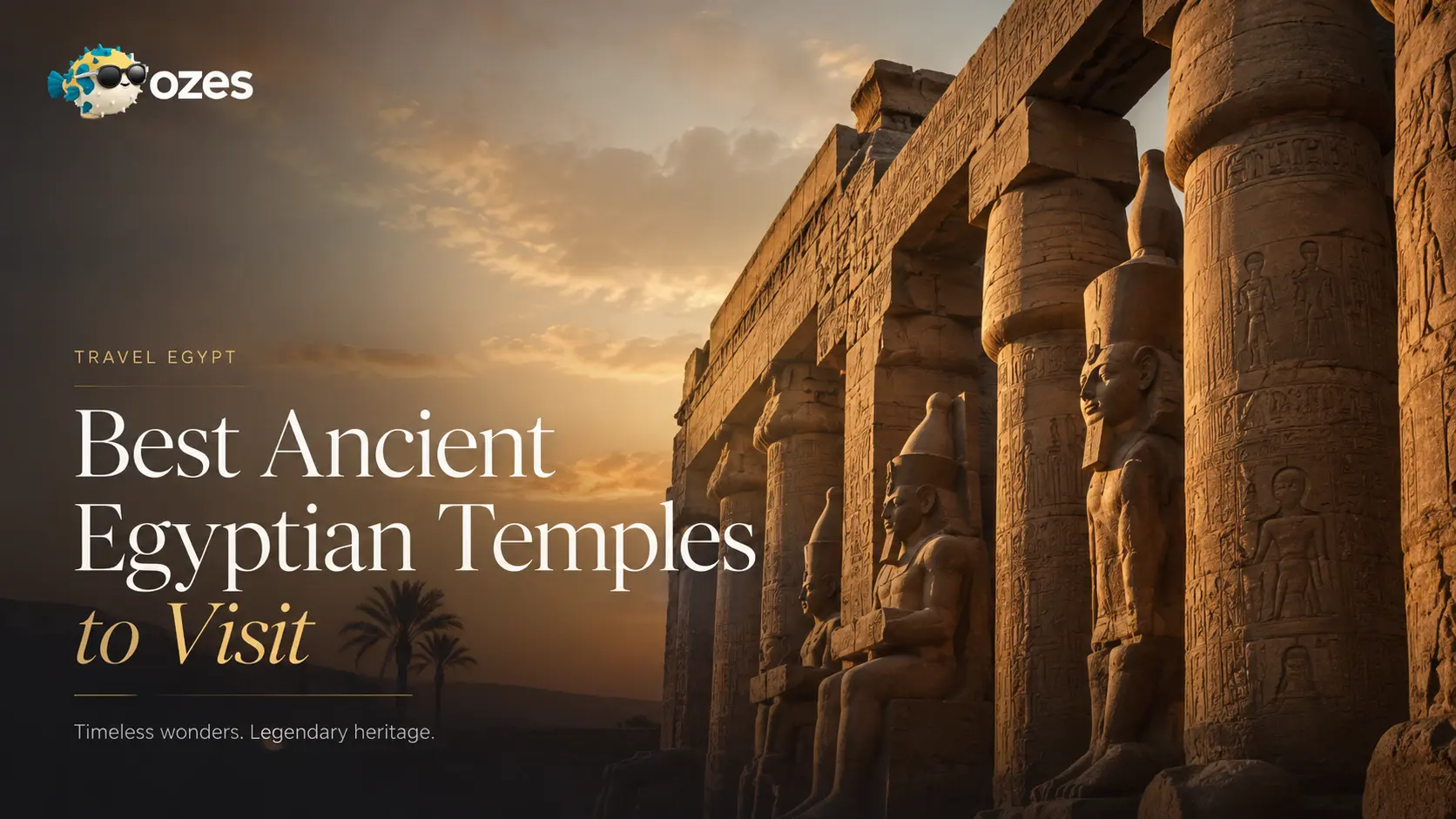
Egypt’s temples are not just stone corridors and carved gods. The best ones still feel active: sun on sandstone, boat horns on the Nile, incense-dark sanctuaries, and walls covered with scenes that reward slow looking.
If you only have time for one temple city, make it Luxor. The concentration is hard to match: vast ceremonial spaces on the east bank, royal memorial temples on the west bank, and a Nile crossing that turns sightseeing into a rhythm rather than a checklist.
The Karnak sanctuary and its forest of columns should sit high on any list of the best ancient Egyptian temples to visit. It was expanded across many reigns, so it feels less like one building and more like a stone archive of power, devotion, and artistic confidence.
Karnak is easiest to appreciate before the heat and crowds build. Don’t rush straight to the most photographed columns; pause at side courts and outer walls, where quieter reliefs often reveal processions, offerings, and small details of daily ritual.
A guide helps here because the site is layered. Without context, it can feel like a spectacular maze; with context, the axes, pylons, sacred lake, and chapels begin to make sense.
The temple beside the modern city is especially atmospheric in late afternoon and evening, when the sandstone warms and the avenue leading toward Karnak starts to glow. It is also one of the easiest major temples to pair with a relaxed dinner or Nile-side walk.
This is a good place to notice continuity. Ancient blocks, later additions, reused spaces, and city life all sit close together, which makes Luxor Temple feel less remote than some desert-edge sites.
Across the river, the terraces of Hatshepsut’s temple look almost architectural rather than carved, set against pale cliffs that intensify the heat and light. Nearby memorial temples such as the Ramesseum and Medinet Habu bring a different mood: heavier walls, battle scenes, and courtyards built for royal memory.
Many travellers combine the west bank temples with tomb visits, but temples need their own mental space. Tombs are intimate and enclosed; temples are public, political, and theatrical.
The best temple is the one you reach before the tour buses.
“Come early for the stones, stay late for the shadows.”— Local guide in Luxor
For a compact introduction, Ozes’ one-day Luxor route covers both sides of the river without asking you to decode the city alone.
 See the Luxor temple circuitA guided day across Luxor’s east and west banks, ideal if you want Karnak, Luxor, and key west-bank sites in one structured route.
South of Luxor, temple travel becomes more river-minded. The journey between Edfu, Kom Ombo, and Aswan is one of the clearest ways to see how ancient religious sites were placed along the Nile, close to trade, farming, and movement.
The Temple of Edfu is popular for good reason: its structure is unusually complete, so visitors can understand the progression from open court to darker inner rooms. It is one of the best choices for travellers who want a temple that still reads clearly as a building.
The riverside temple at Kom Ombo has an unusual paired layout, linked to two different cults. The setting is part of the appeal: boats nearby, soft river air, and reliefs that are easy to examine without straying far from the main route.
It is especially good for people who like specific stories. Look for carved medical instruments, calendars, and repeated symmetrical patterns that reveal how carefully the temple was planned.
The island setting of Philae gives it a different kind of beauty. The short boat approach slows the pace, and the first view from the water is part of the visit, not just transport.
Philae rewards a full loop. Walk through the main temple, then turn back toward the water to see columns, kiosks, and shoreline angles that many people miss on a straight in-and-out visit.
 Explore Aswan’s essential ancient sitesVisit Philae Temple, the High Dam area, and the Unfinished Obelisk with a guided Aswan day plan.
 Connect the temples by Nile cruiseA short Aswan-to-Luxor cruise that naturally links Philae, Kom Ombo, Edfu, and Luxor’s temple landscape.
Abu Simbel is not casual sightseeing. It usually means a very early start from Aswan or a short flight, plus careful planning around transport and heat. The payoff is a façade that still feels engineered to stop conversation.
The great rock-cut temples of Abu Simbel were created for royal power, divine association, and spectacle. The seated colossi are famous, but the interior is just as important: reliefs, sanctuary spaces, and a sense of controlled darkness after the glare outside.
If you are planning a temple-focused Egypt route, Abu Simbel is the major detour worth considering. It is less about adding another stop and more about seeing how far ancient monumentality could be pushed.
Check before you lock it in
Crowds can gather around special solar-alignment periods and peak travel dates, so confirm conditions before building your whole itinerary around one moment.
Not every temple day needs to revolve around the biggest names. Some of Egypt’s most rewarding visits happen at sites where you can hear your own footsteps and spend more time with individual carvings.
North of Luxor, the Temple of Hathor at Dendera is a favourite for colour, ceiling detail, and a more contained layout. It suits travellers who like art history, symbolism, and the feeling of discovering a room gradually rather than being overwhelmed at the entrance.
Abydos, associated with the Temple of Seti I, is another strong choice if you have a serious interest in relief quality and sacred geography. It is often paired with Dendera as a long day from Luxor, best done with a guide and private transport.
On Luxor’s west bank, Medinet Habu’s massive walls make it one of the most satisfying sites for travellers who want colour traces, bold scenes, and fewer distractions than the headline stops. It also photographs well in side light, when the carved reliefs gain depth.
If you are travelling in Aswan and want something beyond the usual circuit, Kalabsha is worth considering when logistics allow. Its lakeside setting gives the visit a calmer, more open feel than many busier temple stops.
Let the light choose the order
For quieter temples, ask your guide where the best light falls before you arrive. A small shift in timing can change flat carvings into deep, readable reliefs.
The best ancient Egyptian temples to visit depend on your route, stamina, and appetite for detail. A first-time traveller does not need to see every site; a stronger plan is to choose a balanced mix of scale, preservation, setting, and story.
Do not judge temples only by size. A smaller site with clear reliefs, fewer crowds, and a strong guide can be more memorable than a famous stop visited when everyone is tired.
Protect your attention
Temple fatigue is real. After two major sites in a day, details can blur, so build in pauses for lunch, a Nile view, or a museum visit.
Temple touring is physical. You walk on stone, stand in sun, move between bright courtyards and dim rooms, and absorb dense history at the same time. The smoother your logistics, the more you will actually see.
A guide is not essential at every site, but it makes a major difference at layered temples such as Karnak, Dendera, and Abydos. At more visually straightforward stops, you may prefer a short explanation followed by quiet time to explore.
 Plan a temple-rich luxury routeA polished multi-day Egypt route with Nile cruise time, useful for travellers who want temples woven into a broader classic itinerary.
Key takeaways
The best temple trip in Egypt is not the one with the longest checklist. It is the one that gives each site enough time to become distinct: Karnak’s columns, Philae’s water approach, Edfu’s complete plan, Abu Simbel’s force, Dendera’s ceilings, Medinet Habu’s carved walls.
When you are ready to plan, preview the route before you commit. Ozes builds Egypt trips around how the days actually feel on the ground, so your temple visits connect into a journey you can picture clearly before you book.